
The Complete Guide to Gold Trade Finance Dubai: Structuring and Capital for Traders

The global precious metals market moves at an incredible speed, and nowhere is this more evident than in the United Arab Emirates. For physical gold traders, refiners, and jewelry manufacturers, managing cash flow presents a persistent hurdle. Capital gets trapped for weeks at a time while bullion sits in transit, undergoes refining, or waits for customs clearance. This delay stunts business growth and limits a company’s ability to seize fresh market opportunities.
Fortunately, the Emirate provides dedicated financial structures built to bridge these exact liquidity gaps. Leveraging gold trade finance Dubai allows businesses to unlock trapped working capital, secure their international supply chains, and comfortably handle high-volume shipments. This detailed guide explores how these financial facilities work, the strict compliance landscape traders must navigate, and how to position a business to secure optimal funding.
What is Gold Trade Finance Dubai?
At its core, gold trade finance Dubai refers to specialized credit facilities, loans, and structured financing options offered by banks, institutional lenders, and private funds to businesses involved in the precious metals supply chain. Unlike standard corporate loans, trade finance is specifically tied to the underlying physical commodity. The gold itself, along with shipping documents and forward contracts, frequently serves as the security for the capital advanced.
This specialized form of financing provides the essential liquidity required to keep international bullion transactions moving smoothly. Without it, scaling an import, export, or refining operation becomes incredibly difficult, as precious metals require massive upfront capital outlays.
Why Dubai is the Global Capital for Gold Financing
Dubai handles roughly 25% of the world’s physical gold trade every single year. The city has earned its historic title, the “City of Gold,” by transforming into a highly regulated, technologically advanced logistics and financial powerhouse. Several structural factors make it the ideal hub for securing asset-backed financing.
The Role of DMCC and DED
The Dubai Multi Commodities Centre (DMCC) is the leading free zone for commodities trading in the region. It hosts thousands of precious metals firms, offering them 100% foreign ownership, modern infrastructure, and direct access to specialized vaults. For traders targeting local retail markets or the famous gold souks, the Dubai Department of Economy and Tourism (DET), formerly known as DED, provides mainland commercial licenses. These clear corporate frameworks give local and international lenders the confidence needed to extend large-scale lines of credit.
Advanced Infrastructure and Security
Lenders are comfortable financing physical commodities in the emirate because the logistics chain is exceptionally secure. With high-security storage facilities like the DMCC Vault, secure transport provided by global entities like Transguard or Brinks, and world-class local refiners, the risk of collateral loss or theft is drastically minimized.
Common Types of Gold Trade Finance Structures

No two trading operations are identical. A wholesale bullion trader moving kilobars between international mints requires a very different financial structure than an regional manufacturer buying raw dore. Lenders offer several distinct products to match these varied requirements.
Pre-Shipment Financing
This structure provides working capital to a buyer before the gold is even loaded onto an aircraft. It allows a Dubai-based trader to advance funds to a trusted mining operation or an international supplier to cover extraction, aggregation, and local security costs. The lender typically releases these funds against a verified Letter of Credit (LC) or a binding purchase contract from an end-buyer.
Post-Shipment and Invoice Factoring
Once the gold has cleared customs and arrived at its destination, a significant payment gap often occurs before the final buyer settles the invoice. Post-shipment financing bridges this exact window.
Through invoice factoring or discounting, a finance provider advances up to 80% or 90% of the invoice value immediately. Once the final buyer pays the remaining balance, the lender releases the retained percentage, minus a small service fee.
Bullion Loans and Gold Consignment
For jewelry manufacturers and refiners, maintaining a steady physical inventory is essential. A bullion loan allows a business to borrow physical gold directly from a bank’s pool instead of borrowing fiat currency to buy it.
The business processes the metal, sells the finished jewelry or refined bars, and then repays the loan either in physical gold or the cash equivalent based on current market rates. This approach acts as a built-in hedge against sudden market price fluctuations.
Expert Insight: Using a bullion consignment model allows regional manufacturers to keep their production lines running at full capacity without tying up millions in capital or exposing their balance sheets to the daily volatility of the spot price.”- Marcus Vance, Senior Commodities Specialist
The Compliance Landscape: Sourcing and Regulations
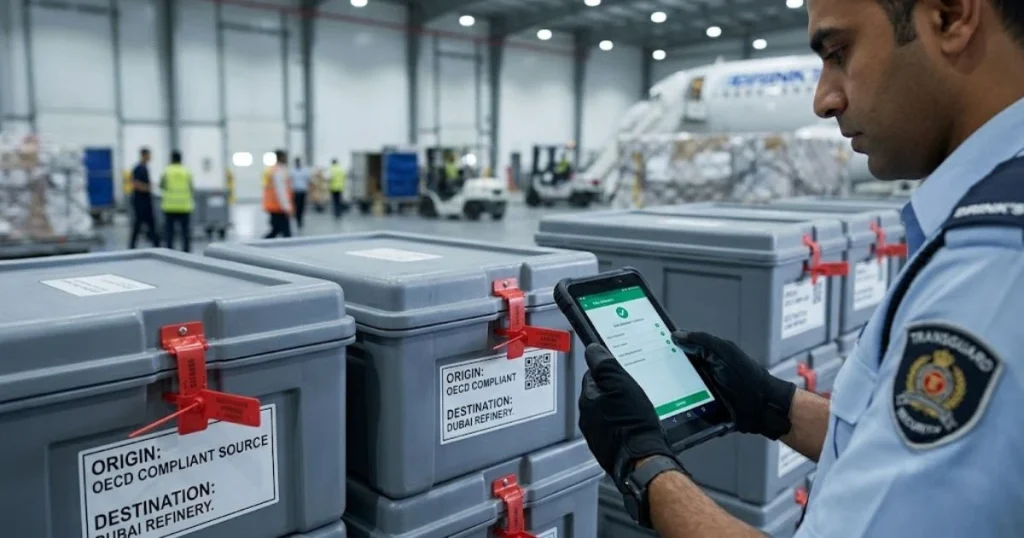
Securing gold trade finance Dubai requires a strict commitment to regulatory compliance. Because precious metals are high-value, highly liquid assets, global financial institutions and UAE regulators enforce stringent anti-money laundering (AML) and counter-terrorism financing (CFT) frameworks.
UAE Due Diligence Regulations for Responsible Sourcing
The UAE Ministry of Economy strictly enforces the Due Diligence Regulations for Responsible Sourcing of Gold. This legal framework applies directly to refiners and dealers in precious metals and precious stones (DPMS). It requires all registered entities to adopt the internationally recognized OECD 5-step framework:
- Establish strong company management systems to track every gram of incoming material.
- Identify and assess risks within the underlying supply chain, especially when importing from high-risk areas. www.moet.gov.ae
- Design and implement a clear strategy to respond immediately to any identified compliance risks.
- Arrange independent third-party audits of the company’s ongoing due diligence practices.
- Report periodically to the Ministry of Economy to maintain an active, fully compliant trading status.
SIRA and goAML Registration
Any business operating a physical gold facility or vault must secure approval from the Security Industry Regulatory Agency (SIRA). SIRA ensures that all premises utilize top-tier surveillance and access controls.
Furthermore, every licensed trader must register on the UAE Financial Intelligence Unit’s goAML platform. This portal is used to log transactions, file mandatory risk reports, and actively prevent illicit funds from entering the financial ecosystem.
Step-by-Step Process to Qualify for Gold Financing
Many newer trading companies mistakenly treat a trade finance application like a standard retail bank account. Because the risks are unique, lenders perform extensive due diligence before approving an open line of credit. Following a structured preparation process is vital.
Secure the Correct Corporate Structure
You must hold a valid commercial license that explicitly lists precious metals trading, refining, or manufacturing as an approved business activity. Setting up within a respected zone like the DMCC provides an immediate advantage, as lenders are highly familiar with their structural and regulatory framework.
Establish an Active Compliance Program
Lenders will ask to review your internal compliance manuals. You need a dedicated, qualified Compliance Officer who actively manages Know Your Customer (KYC) documents for all suppliers and buyers. If you cannot prove exactly where your gold originates and where your payments land, financial institutions will decline your file.
Build a Comprehensive Transaction Profile
Before approaching a lender, pull together a clear transaction folder for the specific trade cycle you want financed. This package should include:
- Proforma invoices and signed purchase agreements.
- Assay certificates confirming the purity of the material.
- Verified transport agreements with licensed logistics providers (e.g., Brink’s, Transguard).
- Evidence of comprehensive all-risk marine insurance policies.
Managing Risk in Gold Trade Financing
Precious metals financing requires navigating unique financial and physical risks. Top-performing trading houses use distinct, active strategies to protect their capital and ensure their credit facilities remain in excellent standing.
Volatility and Price Hedging
The global price of gold shifts every second. If a lender advances capital to buy bullion at $2,400 an ounce, and the market drops to $2,300 while the metal is in transit, the underlying collateral loses significant value.
To prevent this, financiers usually require traders to hold active hedging positions. Using futures contracts or options on regulated exchanges allows traders to lock in their sell price, ensuring they can repay the financed amount regardless of sudden market drops.
Operational and Transport Countermeasures
Physical commodities face real-world transit risks, including logistics delays, customs hold-ups, and security issues at international borders. Working exclusively with globally recognized, secure transport companies ensures the physical cargo is fully tracked and protected from point of origin to the final vault destination.
Choosing the Right Financing Partner in Dubai
The financing market in the region features a mix of traditional commercial banks, regional financial institutions, and specialized private credit funds. Selecting the right fit depends heavily on your company’s size, operational history, and transaction style.
While large commercial banks offer highly competitive interest rates, their onboarding processes are extensive and typically geared toward established firms with years of audited financial statements.
Conversely, boutique trade finance funds and commodity-focused private lenders offer quicker approvals and more adaptive, flexible terms. However, they generally charge higher processing fees and interest margins to balance out their increased risk exposure.
The Long-Term Outlook for Bullion Trade Finance

The future of financing in this sector points toward absolute transparency and digital integration. Regulators and top-tier financial institutions are increasingly exploring blockchain-backed tracking networks. Digital ledgers allow every participant in the supply chain-from the mine to the refinery to the bank-to instantly verify the origin, purity, and legal ownership of physical bars.
Furthermore, compliance standards will only continue to tighten globally. Firms that proactively implement digital transaction tracking, strict ESG (Environmental, Social, and Governance) sourcing rules, and transparent corporate accounting will enjoy preferential access to capital at lower borrowing rates.
Conclusion and Summary
Expanding an international precious metals business requires ready access to reliable capital. Relying solely on cash reserves naturally caps your growth and leaves your company vulnerable to sudden operational delays. By utilizing structured gold trade finance Dubai facilities, your trading house can optimize its cash flow, protect its profit margins via robust hedging, and fulfill larger corporate contracts with absolute confidence. Success in this fast-moving market relies entirely on pairing your industry expertise with an institutional compliance framework that top lenders trust.
Need Capital to Scale Your Gold Trading Operations?
Navigating corporate onboarding, securing security approvals, and structuring trade finance applications requires specialized expertise. Our experienced advisory team helps precious metals firms structure compliant corporate profiles and connect with elite local and international financing institutions.
Contact Our Trade Finance Specialists Today to unlock your working capital and accelerate your business growth.