How to Import Gold from Africa to UAE: The Ultimate Regulatory and Logistics Guide

Navigating international commodity corridors can be incredibly challenging for modern bullion traders and institutional investors. Many buyers face severe roadblocks when trying to establish a secure supply chain, often getting caught up in logistical delays, missing documentation, or unexpected compliance audits at customs checkpoints. Without a clear understanding of cross-border protocols, attempting to import gold from Africa to UAE can lead to frozen assets, heavy financial penalties, or falling victim to sophisticated fraudulent schemes in the sourcing phase.
Fortunately, establishing a reliable, highly profitable, and fully compliant trading route is completely achievable when you follow the structured frameworks enforced by international authorities. By partnering with licensed exporters, utilizing authorized security logistics, and registering with the appropriate UAE free zones, you can seamlessly import gold from Africa to UAE while fully protecting your capital. This comprehensive guide breaks down every phase of the trade corridor, from origin documentation to Dubai customs clearance and final refinery settlement.
Why the Africa-to-UAE Gold Corridor is Growing
The trade highway connecting African mining nations to the Dubai marketplace represents one of the most dynamic commodity corridors in the world. Dubai has earned its reputation as the “City of Gold” by creating an ecosystem designed specifically to facilitate high-volume precious metals trading.
For African exporters and international buyers, the UAE provides unmatched liquidity and direct access to global bullion markets. The region’s advanced refining infrastructure allows raw dore bars to be processed into internationally recognized investment-grade bars swiftly and cost-effectively.
Sourcing Safely: Key African Gold Export Hubs
To successfully import gold from Africa to UAE, you must first understand the regulatory landscapes of the primary sourcing nations. Each country operates under its own distinct mineral commission rules and export structures.
Ghana (West Africa)
Ghana stands as one of the most structured and reliable gold export markets on the continent. All formal exports are regulated by the Minerals Commission and channeled through the Precious Minerals Marketing Company (PMMC). When you manage a project to import gold from Africa to UAE using Ghanaian sourcing, you benefit from a highly transparent audit trail and robust provenance tracking, which makes compliance checks significantly smoother.
Uganda (East Africa)
Uganda has emerged as a major regional transit and processing hub for East African precious metals. The country features competitive pricing structures for both raw nuggets and dore bars. The Uganda Revenue Authority (URA) maintains strict export clearance protocols, which must be fully aligned with your destination paperwork before attempting to import gold from Africa to UAE.
Tanzania
Tanzania offers highly stable, institutionalized mining operations alongside strict government oversight. The Tanzania Mining Commission manages the valuation and issuance of export permits. Sourcing from this region provides excellent legal clarity, ensuring that every shipment can legally import gold from Africa to UAE without triggering supply chain red flags.
Mali and High-Risk Regions
Mali is a top-tier gold producer by volume, but like several other regions, it requires heightened due diligence. The Dubai Multi Commodities Centre (DMCC) mandates rigorous conflict-free sourcing declarations for gold originating from high-risk or conflict-affected areas. If your goal is to import gold from Africa to UAE from these territories, your supply chain tracking must be flawless.
The UAE Legal and Regulatory Framework
The UAE maintains a strict regulatory environment to prevent illicit financial flows and ensure responsible sourcing. Understanding these regulatory bodies is mandatory before executing your first trade.
Dubai Multi Commodities Centre (DMCC)
The DMCC is the primary governing authority for precious metals trading in Dubai. To legally operate a commercial trade, your company must hold a valid DMCC trading license. The DMCC enforces the “Rules for Risk-Based Due Diligence for Responsible Sourcing of Gold,” which align directly with OECD guidelines.
Security Industry Regulatory Agency (SIRA)
SIRA sets the benchmark for physical security, transit safety, and vaulting standards within Dubai. Any commercial entity seeking to import gold from Africa to UAE must cooperate with SIRA-approved logistics providers. This ensures that the physical bullion is protected by military-grade security from the moment it touches the runway.
Anti-Money Laundering (AML) Compliance
The UAE Ministry of Economy mandates strict AML and Counter-Terrorism Financing (CFT) protocols for all dealers in precious metals and stones (DPMS). Traders must register on the government’s goAML portal, appoint a dedicated compliance officer, and maintain rigorous Know Your Customer (KYC) documentation for every single supplier.
Essential Documentation Checklist
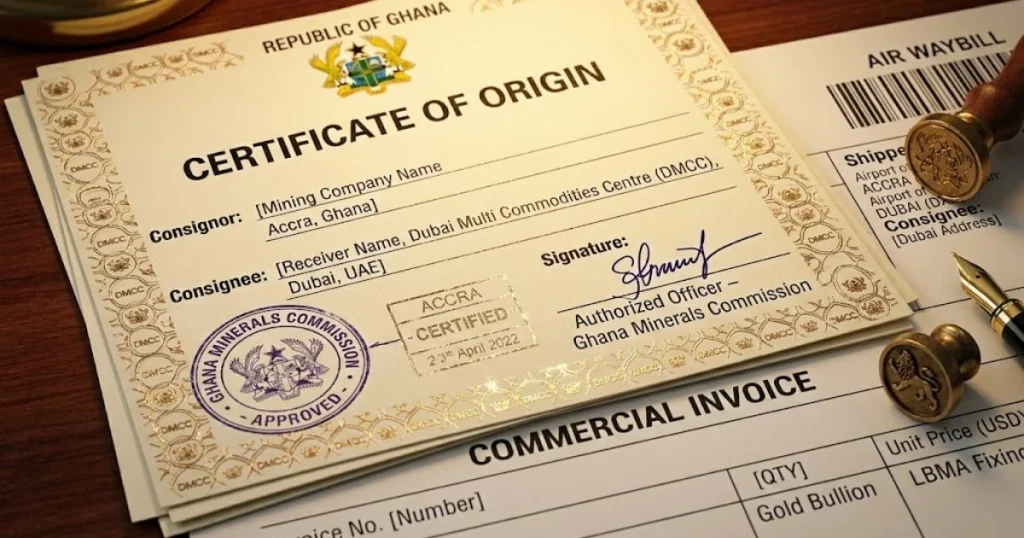
The number one reason shipments are detained at customs is incomplete or mismatched paperwork. To ensure a seamless transaction when you import gold from Africa to UAE, the exact documents below must accompany the consignment.
Primary Shipping and Commercial Documents
- Three Original Proforma Commercial Invoices: Addressed directly to the nominated UAE refinery or licensed corporate consignee, showing the net weight, gross weight, estimated purity, and agreed valuation based on the LBMA second fixing.
- Certificate of Origin: Issued by the mining country’s official chamber of commerce or customs authority.
- Certificate of Circulation of Merchandise: Confirming the legal movement of the physical assets across international borders.
- Air Waybill (AWB): Must be explicitly marked as “Air Freight Prepaid” and categorized strictly as “Valued Cargo.”
Government Clearance and Ownership Proof
- Official Export License / Permit: A valid, non-expired export authorization issued by the origin country’s ministry of mines or mineral commission.
- Certificate of Ownership / Title: A legal declaration signed by the seller confirming they are the lawful, exclusive owner of the goods and that the items are free from any liens or encumbrances.
- Preliminary Assay Report: An initial purity analysis from a reputable, government-approved laboratory in the country of origin.
- Customs Declaration Form / Bill of Entry: Verifying that all export duties, local levies, and taxes have been paid in full prior to departure.
Special Regional Certificates
- UN and Interpol Clearance Certificates: Mandatory for specific regions, such as the Democratic Republic of Congo (DRC) and neighboring Central African nations, proving the gold is not connected to criminal syndicates or militant groups.
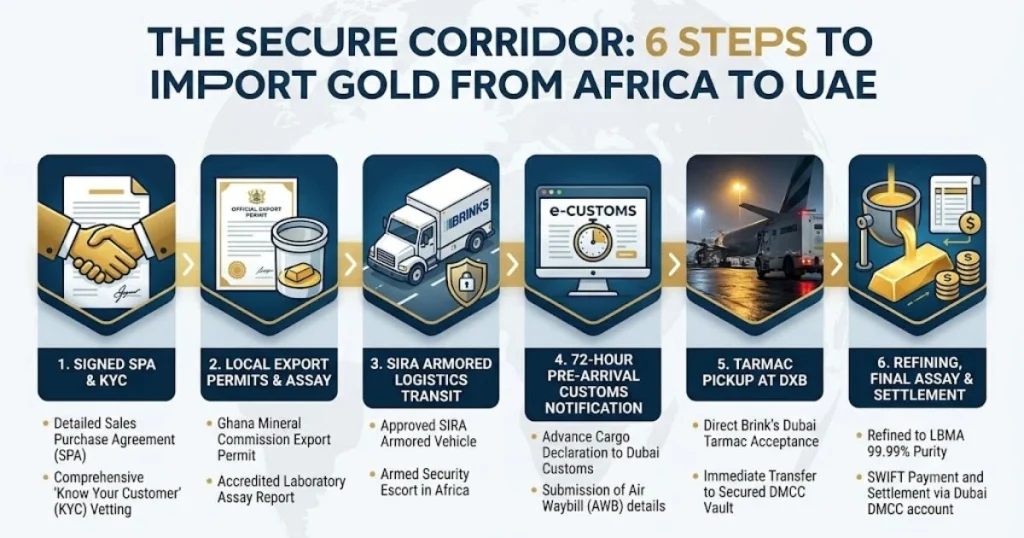
Step-by-Step Logistics and Security Blueprint
To successfully import gold from Africa to UAE, you cannot use standard commercial shipping methods or passenger carry-on allowances for commercial volumes. You must implement an institutional-grade logistics chain.
1.Execute the Sales and Purchase Agreement (SPA):Pre-Transit Phase.
Both parties sign a legally binding contract detailing quantities, target purity, pricing mechanisms, and explicit banking details. Complete comprehensive KYC background checks via the goAML framework before moving forward.
2.Secure Local Export Clearance and Pay Origin Duties:Origin Country Phase.
The seller delivers the raw dore bars to the local government assay office for weighing, sealing, and tax assessment. Ensure all local export fees are paid and secure the official Certificate of Origin.
3.Appoint an Authorized Security Logistics Provider:Transit Phase.
Engage an internationally recognized, SIRA-approved security carrier such as Brinks, Transguard, or G4S. The carrier accepts the sealed cargo directly from origin customs and issues the Air Waybill.
4.Issue the 72-Hour Pre-Arrival Customs Notification:Pre-Clearance Phase.
Transmit copies of all shipping documents, including the AWB and commercial invoice, to the UAE consignee and Dubai Customs at least three business days prior to flight departure. This prepares the system for immediate clearance.
5.Execute Armored Transfer to the Nominated Refinery:Destination Phase.
Upon arrival at Dubai International Airport (DXB), SIRA-regulated security vehicles collect the cargo directly from the tarmac. The shipment is transferred immediately under armed guard to the designated DMCC refinery.
Customs Clearance Procedures at Dubai Airports

When the shipment reaches the UAE, it enters a highly coordinated clearance process managed by Dubai Customs. Understanding the exact codes and labeling rules prevents costly procedural errors.
| Regulatory Parameter | Requirement for Rough Gold / Dore | Requirement for Investment Bullion |
| HS Customs Code | 71081210 (Crude/Raw Ingot Form) | 71081300 (Semi-Manufactured Bullion) |
| Air Waybill Labeling | Must state “Deemed to contain gold” | Must state “Investment Grade Bullion” |
| Customs Duty Rate | 0% (Exempt when entering Free Zones) | 0% (Exempt) |
| Handling Protocol | Mandatory Brinks/Transguard Tarmac Pickup | Authorized Secure Cargo Clearing |
Commercial importers must avoid attempting to bring commercial quantities through the passenger terminal under personal baggage allowances unless they have completed extensive pre-registration and possess a valid UAE trade license. Attempting to pass commercial cargo off as personal items violates federal law and will result in immediate asset seizure.
Refining, Assay, and Final Settlements
Once your security carrier successfully delivers the shipment to the DMCC-licensed refinery, the final processing phase begins. This is where the true value of your import is precisely calculated.
The Inspection and Melting Process
The refinery team inspects the serial numbers on the packaging boxes against the packing list. Once integrity is verified, the raw dore bars are melted down to create a perfectly homogenous alloy. The seller or an authorized representative can oversee this physical melting process with special permission from the refinery management.
The Final Assay Report
After melting, the refinery extracts samples to perform an advanced chemical analysis (typically utilizing fire assay or X-ray fluorescence spectroscopy). This determines the exact gold content down to parts per thousand. This final assay report overrides all preliminary reports generated in Africa.
Financial Settlement and Ownership Transfer
Based on the refinery’s final assay report, the seller generates the final commercial invoice. The buyer reviews the document alongside their corporate banker. Once approved, the funds are transferred via secure bank wire within three working days. Ownership changes hands completely only after the funds clear into the seller’s account.
Avoiding Common Scams and Pitfalls
The international gold trade can attract bad actors looking to exploit inexperienced buyers. Protecting your capital requires unwavering commitment to institutional verification protocols.
1. The “Below-Market Discount” Trap
If a supplier offers raw gold at a 15% to 30% discount off the London Bullion Market Association (LBMA) spot price, it is almost certainly a scam. Genuine gold is a highly liquid global currency; no legitimate miner needs to offer massive discounts to sell their inventory. Normal commercial discounts for raw dore range from 1% to 4% due to refining costs and export duties.
2. Fake Assay Documents and Laboratory Certificates
Never accept assay certificates provided solely by the seller without independent verification. Fraudulent operations frequently forge documentation from non-existent government offices. Always insist on third-party purity verification from an internationally accredited laboratory before initiating any financial transit approvals.
3. Upfront Advance Fee Demands
A common fraudulent tactic involves requesting substantial upfront cash payments for “local registration taxes,” “customs clearance bribes,” or “emergency fuel costs.” Legitimate operations utilize structured financial instruments, such as Letters of Credit or escrow accounts managed by tier-one banks, ensuring that no capital leaves the buyer’s control until the physical gold arrives safely at the destination refinery.
Key Takeaways for Successful Gold Importation
Safely executing an import project requires balancing strict logistical timelines with absolute legal transparency. Keep these three core principles at the center of your operations:
- Flawless Documentation: Ensure every weight, code, and license number matches perfectly across all origin and destination invoices.
- Institutional Logistics: Never cut corners on security. Use only SIRA-approved armored transport from tarmac to vault.
- Rigorous Compliance: Treat AML/KYC checks as an essential shield for your business reputation and corporate bank accounts.
Conclusion
Mastering the trade corridors to import gold from Africa to UAE requires deep operational discipline, strict adherence to international shipping laws, and close cooperation with regulatory bodies like the DMCC and SIRA. By ensuring that your documentation is flawless, utilizing only verified security logistics firms, and avoiding unrealistic below-market offers, you can protect your capital and build a highly profitable trading operation. Navigating these regulatory frameworks successfully ensures your business remains resilient against global compliance updates.
Establish Your Secure Trade Corridor Today
Setting up a fully compliant import route requires specialized corporate structures, bulletproof compliance tracking, and reliable banking relationships within the UAE. Our team specializes in structuring international precious metals transactions, securing DMCC commercial licenses, and implementing institutional AML frameworks.
Contact our trade finance experts today on our website contact us page to schedule an initialization consultation and secure your commodity supply chain immediately.