
Setting up Family Office Dubai: Your Complete Guide to Wealth Management in the UAE

If you come from a high-net-worth family with assets spread across countries, you know the headaches that come with it. Coordinating investments, handling taxes in multiple places, planning who gets what when the next generation steps in, and keeping everything private while staying compliant—it all adds up fast. Many families feel overwhelmed trying to manage everything through scattered advisors or informal arrangements that no longer cut it as wealth grows.
Setting up family office Dubai changes that. It gives you a professional, centralized hub right in one of the world’s most stable and tax-friendly spots. Families who make the move often find better control over their money, smoother succession planning, and real peace of mind. In this guide, we walk through exactly what it takes, why it works so well here, and how to get it done right in 2026.
What Exactly Is a Family Office?
A family office is basically a private team and structure built to handle every aspect of a wealthy family’s finances and more. Think of it as your own in-house wealth management firm, but tailored only to you or your close relatives.
Unlike a regular wealth manager who serves many clients, a family office focuses solely on one family’s needs. It can cover investment decisions, tax planning, estate and succession matters, philanthropy, real estate, and even day-to-day admin like bill paying or travel arrangements.
There are two main types:
- Single Family Office (SFO): Serves just one family.
- Multi Family Office (MFO): Serves several families, often sharing costs and expertise.
In Dubai, most setups start as SFOs because they offer maximum privacy and control. Families with $50 million or more in assets usually go this route, but smaller ones have options too.
The goal stays the same: protect and grow wealth across generations while keeping things efficient and private.
Why Dubai Has Become the Go-To Spot for Family Offices

Dubai stands out for good reason. The city combines zero personal income tax, strong legal protections under English common law in its free zones, and a location that bridges Europe, Asia, and Africa.
Many families moving here talk about the lifestyle upgrade too—top schools, safety, and a business-friendly vibe that makes daily life easier. Plus, the UAE government actively supports family offices through streamlined rules in places like the Dubai International Financial Centre (DIFC).
Recent changes in regulations have made the process smoother. For instance, DIFC updated its Family Arrangements Regulations to cut red tape while keeping strong safeguards. Families now report faster setups and fewer compliance headaches compared to traditional hubs like Switzerland or Singapore.
One advisor who has helped dozens of families relocate put it simply: “Dubai doesn’t just offer tax savings—it delivers a complete ecosystem where your office can actually thrive long-term.”
Key Benefits of Setting Up Family Office Dubai
When families weigh their options, a few advantages keep coming up.
First, tax efficiency. No personal income tax or capital gains tax for individuals. In qualifying free zones, corporate tax can effectively sit at 0% on certain income. This can save millions compared to high-tax home countries.
Second, asset protection and succession planning. Structures like foundations or holding companies in DIFC let you set clear rules for the next generation without forced inheritance laws from other countries.
Third, privacy and confidentiality. Dubai’s free zones keep family details off public registers in many cases, and data protection rules are strict.
Fourth, access to opportunities. Being based here puts you close to booming markets in the Middle East, real estate deals, and alternative investments.
Fifth, lifestyle and family continuity. Kids get world-class education, parents enjoy healthcare and security, and the whole family can stay connected without constant travel.
Real-world example: One European family with real estate holdings across three continents set up their office in Dubai two years ago. They cut their overall tax bill by over 30% and finally created a family charter that everyone agreed on—something they struggled with back home.
Choosing the Right Jurisdiction in Dubai
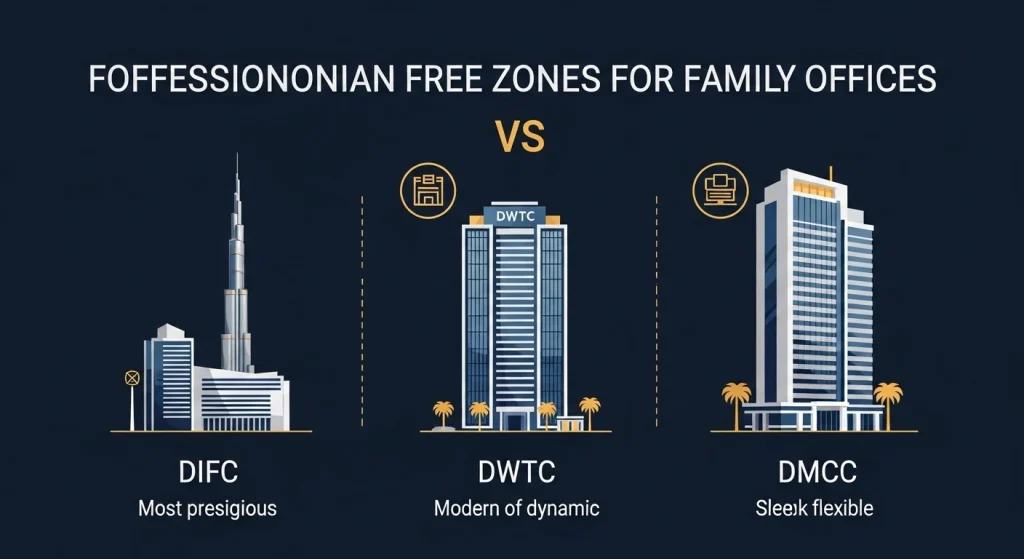
Not every free zone works the same way. Here’s a quick comparison of the main options for setting up family office Dubai.
| Jurisdiction | Minimum Asset Requirement | Typical Setup Time | Annual License Cost (approx.) | Best For | Office Requirement |
|---|---|---|---|---|---|
| DIFC | USD 50 million net assets | 4–8 weeks | USD 12,000 + | Large families, full regulation, prestige | Physical office in DIFC |
| DWTC | AED 500,000 liquid assets (held 12 months) | 4–6 weeks | Lower than DIFC | Smaller families, simpler setup | Physical office in DWTC |
| DMCC | Flexible (often lower) | 3–6 weeks | AED 15,000–50,000 range | Cost-conscious setups, trading focus | Flexi-desk or office options |
DIFC remains the gold standard for serious wealth because of its independent regulator (DFSA) and mature ecosystem. But if your family sits below the $50 million mark or wants a lighter touch, DWTC or DMCC can work well and still deliver strong benefits.
Always match the choice to your family’s size, complexity, and long-term goals.
Step-by-Step Process for Setting Up Family Office Dubai
Here’s the practical roadmap most families follow in 2026.
1. Define Your Objectives and Family Governance
Start internally. Gather key family members and write down what you want the office to achieve—investment returns, risk levels, philanthropy focus, succession rules.
Create a simple family charter or constitution. This document outlines decision-making, roles, and values. Many families bring in a neutral facilitator for these conversations to keep things smooth.
2. Engage Professional Advisors Early
Do not go it alone. Hire a Dubai-based lawyer familiar with free zone rules, a corporate service provider, and a tax advisor. They will guide you through the paperwork and avoid costly mistakes.
A good team typically includes:
- Corporate setup specialist
- Wealth structuring expert
- Accountant
- Banker
Expect this phase to take 2–4 weeks of meetings.
3. Choose Structure and Jurisdiction
Decide SFO or MFO, then pick DIFC, DWTC, or DMCC based on the table above. Your advisors will run the numbers and recommend the best fit.
4. Prepare and Submit Application Documents
Common items include:
- Passport copies and proof of family relationships (birth certificates, affidavits)
- Evidence of net assets or liquid funds (bank letters, statements)
- Business plan outlining services and family needs
- Proposed company name and structure
- Family details form (especially for DIFC)
For DIFC, you must confirm the $50 million threshold.
Submit through the online portal of the chosen free zone.
5. Obtain Approvals and License
Initial approval usually comes within days. Full licensing follows once documents clear. You sign the Memorandum and Articles of Association, pay fees, and receive your certificate.
6. Set Up Operations
- Lease office space (mandatory in most zones)
- Open corporate bank accounts
- Hire key staff (CEO, investment analyst, compliance officer)
- Implement systems for accounting, compliance, and data security
7. Launch and Monitor
Once live, review performance quarterly. Many offices start small and scale as needs grow.
The whole process typically wraps up in 1–3 months if everything is prepared well.
Understanding Costs Involved

Setting up family office Dubai is an investment, but numbers are more predictable than people expect.
Typical first-year breakdown (DIFC example):
- Application and license fees: USD 20,000
- Corporate service provider and legal: USD 10,000–25,000
- Office lease: USD 20,000–50,000+
- Setup of governance documents and systems: USD 15,000–30,000
- Visas and establishment card: USD 5,000–10,000
Total first year often lands between USD 70,000 and USD 150,000 depending on scale. Ongoing annual costs run 40–60% of that.
DWTC and DMCC options can start 30–50% lower for families who qualify.
Remember to budget for professional fees—they pay for themselves by preventing compliance issues later.
Tax Advantages and Wealth Planning Opportunities
One of the biggest draws remains the tax setup. Individuals pay no tax on investment income or capital gains. Qualifying entities in free zones can enjoy 0% corporate tax on relevant income when conditions are met.
You can structure holdings through foundations or SPVs for extra protection and flexibility. Many families also use Dubai-based offices to manage global portfolios while staying compliant with their home country’s reporting rules (like CRS or FATCA).
Succession planning becomes far easier with local tools such as DIFC wills that respect your wishes instead of default foreign laws.
A quick tip: Work with advisors who understand both UAE rules and your home jurisdiction to avoid double taxation or reporting traps.
Building Your Team and Day-to-Day Operations
The right people make or break a family office. Start with a small core team:
- Chief Executive or Family Officer
- Investment professional
- Compliance and risk manager
- Executive assistant
Outsource specialized work (legal, audit, IT security) to keep overhead low.
Set clear KPIs from day one—portfolio performance, cost ratios, family satisfaction scores. Many offices use simple dashboards that the whole family can review.
Common Challenges and How to Overcome Them
Families often underestimate the time needed for internal alignment. Solution: Hold structured family meetings early and document agreements.
Regulatory changes happen—stay ahead by choosing experienced local partners who monitor updates.
Hiring the right talent in a competitive market takes effort. Offer competitive packages and highlight Dubai’s lifestyle.
One family shared that their biggest early win came from hiring a compliance expert on day one instead of trying to handle it themselves later.
Real-World Examples and Lessons Learned

Consider the Asian family that relocated their office to DIFC last year. They consolidated holdings worth over $80 million, created a clear succession plan for three children, and now enjoy quarterly family investment reviews in person.
Another European group used DWTC because their assets sat just under the DIFC threshold. They saved on setup costs while still gaining full asset protection and tax benefits.
These stories show that the right jurisdiction and early planning turn setting up family office Dubai from a complex project into a strategic advantage.
Future Outlook for Family Offices in Dubai
Demand keeps growing. With more families moving to the UAE and the government rolling out supportive policies, Dubai is solidifying its position as a global wealth hub.
Expect continued focus on digital tools, sustainable investing, and next-gen involvement. Offices that build strong governance now will be best positioned for whatever comes next.
Conclusion
Setting up family office Dubai offers a smart, forward-looking way to manage, protect, and pass on wealth. From tax savings and regulatory clarity to lifestyle benefits and professional support, the advantages are clear for families ready to take the next step.
If you have been thinking about centralizing your family’s affairs and want expert guidance tailored to your situation, the time to act is now. Reach out to our team today through the contact form on our website—we’ll walk you through the options, answer your questions, and help you start the process with confidence.