
Dubai Gold Standard vs LBMA: The Ultimate Guide for Smart Gold Investors
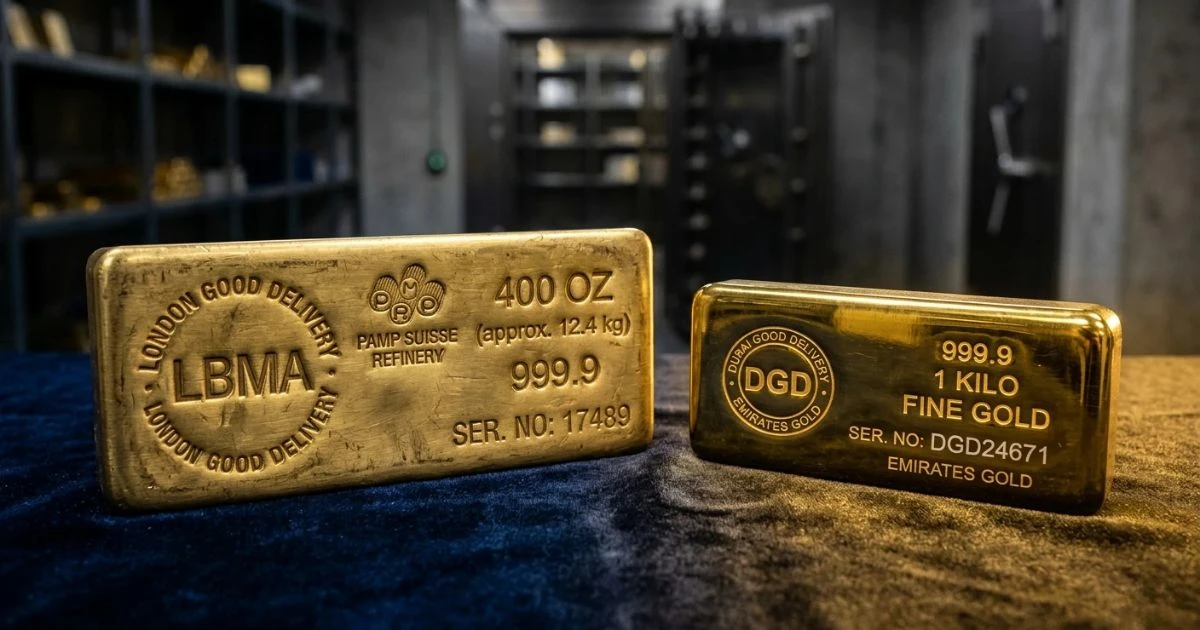
When you step into the world of precious metals investment, you quickly realize that gold isn’t just about weight and shine. It runs on international guidelines that dictate its worth, purity, and overall ease of trading. If you have been looking to buy or store bullion, you have likely run into two massive regulatory benchmarks: the Dubai Good Delivery (DGD) standard and the London Bullion Market Association (LBMA) standard.
Navigating the choice between the Dubai gold standard vs LBMA can feel overwhelming, especially when thousands of dollars of your hard-earned capital are on the line. Many buyers worry about whether a gold bar purchased in the Middle East will carry the same weight, prestige, and resale value when traded in Europe, the Americas, or Asia. Selecting the wrong type of bullion or misunderstanding regional regulations can leave you facing unexpected discount fees or liquidity bottlenecks when it comes time to liquidate your asset.
Fortunately, understanding the core dynamics of the Dubai gold standard vs LBMA is straightforward once you break down the physical specifications, target markets, and systemic structures behind each benchmark. This comprehensive guide will untangle the complexities, weigh the operational differences, and help you determine exactly which regulatory standard matches your specific wealth preservation goals.
What is the LBMA Good Delivery Standard?

The London Bullion Market Association (LBMA) is widely considered the ultimate global authority for precious metals. Established in its modern form in 1987, but rooted in centuries of London banking history, the LBMA sets the ultimate benchmark for the quality, purity, and origin of gold bars traded across institutional networks.
The Institutional Standard
When people talk about the LBMA standard, they are referring to the “London Good Delivery” list. This is an exclusive registry of gold refineries worldwide that have proven their ability to meet incredibly strict manufacturing criteria. If a refinery loses its spot on this list, institutional buyers will immediately stop accepting its products without independent verification.
Physical Characteristics of LBMA Bars
The LBMA system is explicitly designed to keep massive institutional markets moving smoothly. Because of this, it prioritizes a giant bar format that might surprise everyday savers.
- Weight Requirements: A standard LBMA Good Delivery gold bar is large, weighing roughly 400 troy ounces (around 11 to 14 kilograms).
- Minimum Purity: The gold must have a minimum fineness of 995.0 parts per thousand, which equals 99.5% pure gold.
- Stamping and Markings: Every single bar must be clearly stamped with a unique serial number, the refinery’s registered trademark, the exact fineness, and the four-digit year of manufacture.
These enormous bars form the foundational backing for the global banking system, central bank reserves, and large-scale exchange-traded funds (ETFs).
What is the Dubai Gold Standard (Dubai Good Delivery)?

While London holds historical dominance over institutional trading, Dubai has rapidly transformed into the physical center of the global gold trade. To support this massive volume, the Dubai Multi Commodities Centre (DMCC) introduced the Dubai Good Delivery (DGD) standard in 2005. This framework was later enhanced by the UAE Good Delivery (UAEGD) system to formalize quality benchmarks across the region.
The Retail and Regional Champ
The Dubai gold standard was created to address a specific gap in the global market: the immense demand for smaller, highly accessible, physical gold products across the Middle East, Indian subcontinent, and broader Asian retail spaces. While the LBMA focuses heavily on giant bars for bank vaults, Dubai’s framework champions the bars that individual retail investors actually buy, handle, and store.
Physical Characteristics of Dubai Good Delivery Bars
Because it targets both commercial distribution and retail saving, the physical rules of the Dubai gold standard are optimized for a highly flexible range of bar weights.
- Weight Requirements: While the DGD system certifies large bars, it uniquely standardizes smaller investment formats, specifically focusing on bars under one kilogram, such as the 100-gram bar and 10-tola bars.
- Purity Benchmarks: Just like its London counterpart, the baseline purity for a certified Dubai bar is 995.0 parts per thousand (99.5%). However, Dubai refineries frequently focus their commercial output on ultra-pure 999.9 fine gold (24-karat) to satisfy the strict preferences of regional retail consumers.
- Visual Markings: Every approved bar must carry the certified refinery stamp, exact weight, tested purity, and a clear serial number to ensure full traceability throughout the commercial supply chain.
Dubai Gold Standard vs LBMA: Side-by-Side Comparison
To truly grasp how these two operational frameworks interact, it helps to view their technical parameters, target users, and structural setups side-by-side.
| Feature | LBMA Good Delivery Standard | Dubai Good Delivery Standard (DGD) |
| Governing Authority | London Bullion Market Association (LBMA) | Dubai Multi Commodities Centre (DMCC) / UAEGD |
| Primary Market Focus | Global central banks, institutional vaults, ETFs | Physical bullion trading hubs, retail investors, jewelry manufacturing |
| Standard Bar Weight | Large bars (~400 troy ounces / 12.5 kg) | Flexible ranges, highly popular for 1 kg, 100g, and small kilobars |
| Minimum Fine Purity | 99.5% (995 parts per thousand) | 99.5% (995), with extensive focus on 99.99% (9999) |
| Primary Settlement Type | Highly reliant on unallocated paper/derivative claims | Built on fully allocated physical delivery and settlement |
| Global Liquidity | Universally accepted without question worldwide | Exceptionally high liquidity across Asia, the Middle East, and Africa |
Key Differences: Purity, Sizes, and Market Access
To deep dive into the debate of the Dubai gold standard vs LBMA, we have to look past the basic measurements and analyze how these metrics impact your day-to-day investing experience.
Bar Dimensions and Everyday Usability
The most immediate operational difference centers on how much capital you need to participate. Because the foundational LBMA bar weighs roughly 12.5 kilograms, buying a single standard London trade bar requires hundreds of thousands of dollars. This clearly prices out the everyday saver.
Conversely, the Dubai gold standard treats small-scale physical ownership as a primary focus. By creating strict regulatory guardrails around smaller bars (like 100-gram and 1-kilogram sizes), the DMCC ensures that retail buyers can easily purchase institutional-grade gold without needing institutional-scale wealth.
Purity Choices and Consumer Traditions
While both administrative bodies enforce a baseline purity threshold of 99.5%, the commercial output of their respective networks reflects different regional desires.
In Western banking systems managed under LBMA rules, 99.5% purity is completely acceptable for stacking in large vaults. However, in Eastern and Middle Eastern consumer cultures, anything less than 99.99% pure gold is often frowned upon. Consequently, refineries operating under the Dubai gold standard produce massive amounts of 24-karat (999.9 fine) kilobars to satisfy consumer preferences for absolute elemental purity.
Market Liquidity and International Acceptance
Liquidity is simply the ease and speed with which you can convert your physical gold back into cash without taking a financial haircut on the spot price. How do these two frameworks stack up globally?
The Universal Nature of LBMA Bars
Because of London’s historical role as the core clearinghouse for global finance, an LBMA-stamped bar is essentially cash anywhere on earth. Central banks, sovereign wealth funds, and major commercial banks will buy an LBMA bar instantly without requiring it to be melted down or re-assayed (tested for purity). This makes it the single most liquid physical asset class in existence.
The Rising Power of Dubai’s Physical Network
A common misconception is that gold minted under the Dubai gold standard cannot be sold internationally. That is completely untrue. Dubai Good Delivery bars enjoy immense, frictionless liquidity across the vast majority of global growth markets, including India, mainland China, Southeast Asia, and East Africa.
However, if you bring a strictly DGD-certified bar (from a refinery that does not also hold an LBMA accreditation) to a conservative institutional bank vault in London or New York, they might require the bar to go through a local assay process or be refined again. This step can add small administrative costs and minor delays to your transaction.
Regulatory Frameworks and Supply Chain Integrity
In the modern precious metals industry, how your gold is sourced matters just as much as its final purity. Both London and Dubai have developed extensive verification frameworks to protect the market from illicit sourcing.
LBMA Responsible Sourcing
The LBMA runs an intensely rigorous Responsible Sourcing Programme. Refineries must completely prove that their raw gold does not originate from conflict zones, does not fund human rights abuses, and complies with strict anti-money laundering (AML) laws. Independent, third-party audits are mandatory to maintain a listing.
Dubai’s Modern Regulatory Shift
In the past, critics sometimes pointed out regulatory variances between Middle Eastern and Western supply chains. However, Dubai has completely closed that gap over the past several years.
The introduction of the strict UAE Good Delivery standard and mandatory risk-based due diligence rules aligned Dubai’s supply chain oversight directly with international standards. Today, any refinery stamped under the modern Dubai gold standard undergoes rigorous, independent audits covering ethical sourcing, environmental safety, and financial compliance.
The Paper vs. Physical Settlement Showdown

One of the biggest structural divides when comparing the Dubai gold standard vs LBMA comes down to how trading actually happens on the ground.
London’s Derivative-Heavy Model
The vast majority of daily trading volume under the LBMA framework occurs via unallocated gold accounts. When you hold an unallocated account in London, you do not actually own a specific, numbered gold bar sitting on a shelf. Instead, you are a general creditor to a bank that promises to pay you the equivalent value of gold. It acts much like a fractional reserve banking system, where paper claims vastly outnumber the actual physical bars sitting in the vaults.
Dubai’s Physical Settlement Focus
Dubai has taken a radically different strategic path, positioning itself as the undisputed capital of actual physical delivery. As documented by industry reports from global bullion entities like Zawya, the modern gold market is undergoing a structural split:
While Western financial hubs deal extensively in paper derivatives and unallocated claims, Eastern hubs like Dubai, Shanghai, and Singapore focus directly on allocated metal and immediate physical settlement.
When gold trades through the Dubai infrastructure, actual physical bars move into secure, fully allocated vaults. This makes the Dubai gold standard highly appealing to independent investors who do not trust paper financial systems and want absolute proof of physical ownership.
Expert Insights: Choosing What Fits Your Portfolio
To bring some real-world context to the choice between the Dubai gold standard vs LBMA, we can look at how professional wealth managers and portfolio strategists approach the issue.
The Institutional Investor’s Take
For institutional funds or high-net-worth individuals building multi-million-dollar portfolios inside traditional Western banking channels, the advice is clear:
“If your gold strategy relies on interfacing with traditional Western banks, international futures exchanges like COMEX, or European vaulting networks, sticking strictly to LBMA Good Delivery bars is the most efficient path. It completely removes any potential friction during massive institutional settlements.”
The Physical Collector’s View
For private investors looking to hedge against systemic banking risks, currency inflation, or geopolitical instability, a different strategy emerges:
“For the private investor who wants real gold in hand, Dubai Good Delivery kilobars or 100-gram bars offer an exceptional sweet spot. You get world-class manufacturing quality, verified ethical sourcing, and highly competitive regional premiums. In terms of raw, physical survival insurance, a 24-karat Dubai kilobar is as good as it gets.”
Practical Examples: Real-World Buying Scenarios
Let’s look at two practical examples to see how the choice between the Dubai gold standard vs LBMA plays out in everyday life.
Scenario A: The European Retail Savers
Consider an investor living in Germany who wants to shift 10% of their paper retirement portfolio into physical gold bars stored in a secure local vault. They want absolute assurance that any local coin shop or regional bank can buy those bars back in ten minutes without an assay fee. For this investor, buying bars from a Swiss refiner like Valcambi or PAMP Suisse that carries full LBMA accreditation is the most logical choice.
Scenario B: The Expat Investor in the Gulf
Now consider an international expat living and working in Dubai. They decide to allocate a portion of their income to gold by purchasing 100-gram physical bars directly through a DMCC-certified broker.
Because they are buying locally within Dubai’s ultra-competitive ecosystem, the premiums over the spot price are incredibly low. They plan to eventually relocate to Singapore or India. Because Asian markets fully recognize and highly value Dubai Good Delivery gold, this investor benefits immensely from Dubai’s lower purchase premiums without sacrificing regional resale liquidity.
How to Verify Gold Bar Authenticity and Accreditation

Regardless of which side you land on in the Dubai gold standard vs LBMA comparison, protecting yourself from counterfeit products or unaccredited refiners should be your highest priority.
Steps to Take Before You Buy
- Check the Live Lists: Both the LBMA and the DMCC maintain live, updated lists of accredited refiners on their official websites. Before buying a bar, look up the stamped refiner to ensure they are currently listed in good standing.
- Verify the Assay Certificate: Every reputable investment-grade gold bar comes with an assay certificate. This document lists the bar’s unique serial number, weight, fineness, and the signature of the certified assayer. The serial number on the paper certificate must perfectly match the number stamped directly into the gold bar.
- Inspect the Physical Security Features: Modern accredited bars feature advanced security marks, such as micro-engravings, holographic elements (like PAMP’s Veriscan technology), or tamper-evident blister packaging. Never buy a bar if the protective packaging looks broken, scratched, or altered.
Conclusion: Which Standard Wins the Gold Crown?
When weighing the final verdict on the Dubai gold standard vs LBMA, it is important to realize that one is not inherently “better” than the other. Instead, they serve completely different operational needs within the global financial architecture.
The LBMA standard remains the undeniable sovereign benchmark for institutional banking, large-scale central bank reserves, and global derivative markets that require absolute, frictionless cross-border settlement. Meanwhile, the Dubai gold standard has proven itself to be an incredibly reliable, ethical, and highly efficient powerhouse for direct physical trading, regional liquidity, and accessible retail investment options across the world’s fastest-growing economies.
Your choice should ultimately come down to where you live, how you plan to store your metal, and your long-term liquidation strategy. If you want ultra-pure physical gold bars with low purchasing premiums and have your eyes on global physical settlement, Dubai’s framework offers everything you need. If you require absolute universal acceptance inside Western institutional bank vaults, the London benchmark remains the gold standard.
Secure Your Wealth with Trusted Bullion Expertise Today
Ready to take the next step in securing your financial future with institutional-grade physical gold? Whether you are looking to acquire universally recognized LBMA-accredited bars or want to capitalize on the competitive premiums of the physical Dubai gold standard, our team of dedicated precious metals specialists is here to guide you through every step of the sourcing, verification, and secure vaulting process.
Don’t leave your wealth preservation to chance. Contact Us Today to speak with an expert and discover the optimal gold investment strategy tailored specifically to your financial goals.